
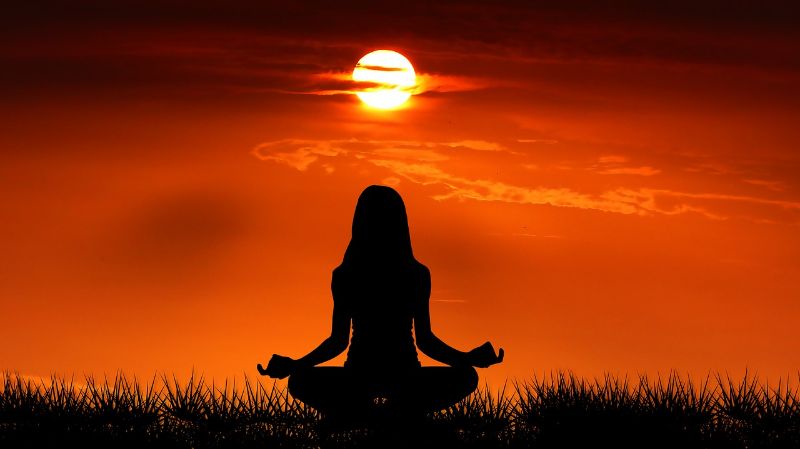
Make a space or nook where you may think, be silent, go inside, and focus yourself. You have a lot to think about and accomplish in your daily life. You barely have time for yourself between work, children, and errands. This is why you need a specific space where you may reconnect with your inner self and soul. It will call out to your soul if you build a space in your home that encourages stillness “Come in, take a seat, and listen.” Here are eight suggestions for making a sacred space:
Before You Continue...
Do you know what is your soul number? Take this quick quiz to find out! Get a personalized numerology report, and discover how you can unlock your fullest spiritual potential. Start the quiz now!
1. Designate an attic or guest room for self-nourishment, or just allocate a corner or window seat in your living room. a location that you feel suitable “Sacred” sets the tone for introspection right away.
2. Use a screen, beads, or a billowy curtain to stress the value of nature as a place of seclusion. This sacred space can be utilized for receiving inner direction and information, as well as writing, drawing, painting, chanting, playing an instrument, or simply listening to the birds sing outdoors.
3. Place pillows on the floor or choose a comfy chair that supports your back to create an atmosphere conducive to contemplation, meditation, or prayer.
4. Create an altar with spiritual things to attract spiritual energy. Each thing can be put with the purpose of reaching deep into your soul and heart.

5. A basic altar can be made by wrapping a small table with a particular fabric. Place items that bring in the earth element, such as a fragrant candle, incense burner, essential oil diffuser, or natural materials like rocks and seashells, on top of the table. You can also include a symbol representing your faith or spiritual practice.
6. Add flowers and plants for more energy, color, and oxygen. Spirituality is symbolized by lavender and purple, while pink opens the heart, green restores nature's equilibrium, and yellow promotes health.
7. To instill a sense of calm and harmony, hang photos of gardens, mountains, spiritual gurus, angels, or mentors.
8. Inspire yourself with soft music and a thought-provoking book. Spiritual poetry by mystics like Rumi can serve as a portal to spiritual contemplation.
Ask for direction, connect with the divine, practise yoga, practice deep breathing, and build a positive vision for your life in your personal nook. You'll feel calmer, clearer, happier, and more encouraged to follow your heart as you reflect on your inner life.
How do I create a spiritual place?
Because of the daily stresses that many of us face, sacredspaces are becoming increasingly important in our daily lives. Finding a specific spot where you can relax, contemplate, and feel peace can be an important part of your self-care and health regimen.
You've probably heard the expression “home is where the heart is,” which means “home is wherever our loved ones are.” It can also be read as “home is where the heart is,” because our hearts are filled with happiness, wonderful memories, love, and comfort while we are at home.
Most of us aim to make our homes feel warm and inviting, as well as to provide a setting where we may cultivate happiness and create shared memories with our loved ones. This is a beautiful thing since it nourishes and improves our interpersonal ties.
However, we frequently miss creating room for our relationship with ourselves with the same care and attention.

I advise you to think about making your home a relaxing and nurturing getaway for your inner life as well as a pleasant location for your outward self.
When we're alone with ourselves, our inner life might be characterized as the thoughts, emotions, sentiments, and intentions that occupy our minds. When it comes to generating comfort in our living places, our inner lives require just as much care and attention.
Creating holy space in your house a place where you can connect with your inner self is one of the finest ways to do this. You can connect with your inner self in a variety of methods, including meditation, self-reflection, journaling, yoga, and prayer, to mention a few.
In today's post, we'll go over some of the actions you may take to make sacred spaces in your house. I'll also provide some ideas and suggestions for how you might use sacred spaces to find more inner calm and connection in your everyday life.
Below, we'll go over what a holy place is, why it's important to establish one, and how you may make your own sacred area in your house.
Decide Your Altar's Purpose
Aside from comfort and convenience, secular altars have few requirements. If you're creating a meditation space, all you need is a comfortable location to sit or lay down. If you're going to use your altar for reading and journaling, it'll need to have a place to keep your books and pens, as well as be well-lit.
Choose a Space for Your Altar
It can be as large as a spare room or as small as a bookshelf or a windowsill.
You should also think about the cardinal direction your altar faces. Some Christian groups, for example, position altars on the eastern side of the church to symbolize the rising sun and resurrection. You may also want your altar to face a direction that is special to you at home. Some people place their altars facing the direction of their motherland and ancestors.
If erecting a fixed altar in your home seems impractical right now, keep reading to the end of the post, where I provide a fun and ingenious suggestion for creating a pocket altar that is both movable and unobtrusive.

Consider a peaceful location with some seclusion. If you live with others, attempt to choose a spot that won't get in the way of others or be easily knocked over.
Examine whether the area is suitable for your requirements and feels ‘right'. Is it or can you make it calm, tranquil, and private? Is the energy in the room clear, bright, and friendly?
You can energetically ‘clear' the location you chose by burning incense or essential oils if you want to add a little enchantment.
If you're interested in doing a smoke cleanse (using white sage smudge sticks), make sure you get your herbs from Native American and Indigenous vendors. Many Native American countries regard smudging to be sacred medicine, and practice was illegal in the United States until 1978.
Gather Tools and Objects for Your Altar
Collect any tools or objects you'd like to keep on your altar using your intuition. Gather anything that speaks to your heart and'sparks joy,' as Marie Kondo would say, unless you're pursuing a certain spiritual path with precise restrictions on what to include.
- Photographs of your forefathers and mothers (when showing images of the deceased is appropriate in your culture)
- Souvenirs and memorabilia from significant spiritual or political turning points (e.g., an object from your first rally, a gift from a mentor, etc.)
- Flowers and plants (especially if the altar intends to reflect and celebrate the changing seasons)
- A shot glass of bourbon, fruits, or a little dish of rice and grains are examples of food offerings.
- Tarot cards, runes, oracle cards, or a crystal ball are examples of divination equipment.
What you keep on your altar has no criteria or limitations. You should never feel obligated to purchase altar accoutrements or believe that your altar isn't ‘complete' until it includes a cauldron, censer, chalice, wand, crystals, eighteen pillar candles in various colors, and other such items.
If you've never kept an altar before, I recommend starting simply with a single candle and a photograph of someone who represents something you want to grow more of in your life.
If and when it feels right to you, you can gradually add to your altar throughout the weeks, months, and years.
Arrange Your Altar
After you've cleansed your altar space (physically and/or spiritually), consider how you'd want to arrange the precious things you've collected on your altar.

Simple is better here, as having fewer artifacts will make it easy for them to find a place on your new altar.
If you want to protect the surface of your altar from incense ash or candle wax, start by laying down an altar cloth or a plate.
Many spiritual practices for altar building follow the rule of symmetry. Consider starting with the largest or tallest item and working your way outwards. You can also use plants/flowers, candles, and photos to symbolically match your favorite thing in the middle.
Work With Your Altar
If you're overwhelmed, starting with only one modest ritual per season is perfectly acceptable. Perhaps you clean and repaint your altar at the start of each season, putting out objects that signify the new season. For example, in the spring, you may put out a vase of fresh flowers, in the summer, sand and seashells, in the fall, pumpkins, and in the winter, holly and white candles.
Consider spending at least five minutes a day or fifteen minutes a week at your altar to meditate, journal, or set intentions if your goal with your altar is to build a more frequent practice of spiritual self-care.
My new moon and full moon rituals are two activities you can begin conducting at your altar every lunar cycle to give yourself time to check in with yourself.
The more you use your altar, the more it will become a sacred focal point in your daily life, amplifying warm, wonderful vibes throughout your house.
Because we all exist in the same universe, it's important to remember that we're all the same behind the layers of race, color, and gender. The gift of stars has been bestowed upon you.
How can I make my room a spiritual room?
Distractions should be kept to a minimum in a spiritual room. Consider installing curtains or light-blocking draperies to any windows in the room that face a roadway or another noisy or distracting place. In a spiritual room, soundproofing materials may also be useful. If you don't like being alone, try installing a little tabletop fountain or wind chimes outside your window. A music system in the room, which allows you to play peaceful or uplifting music or recordings of rain, the ocean, or other natural noises, may also be beneficial.
How do I create a meditation space in my bedroom?
We have a kitchen and a bedroom where we eat and sleep. It's only natural to designate a room to meditation if we wish to foster tranquility and strengthen our practice.
“There are so many impediments to meditation that having a dedicated area removes some of them,” says Ralph De La Rosa, author of The Monkey Is the Messenger: Meditation and What Your Busy Mind Is Trying to Tell You, an upcoming book. “We know that when we engage in a habit on a regular basis, the brain receives the message and absorbs it more readily. Your body and neural network will learn that this is when we do that thing when we settle down for a moment and go within if you sit in the same area at or around the same time.”
It is not necessary to have a separate meditation room in your home. A nook, alcove, or even a closet can be used as a storage space. You might even be able to make one in your own backyard or garden.
“Having a physical place is nice, but what truly matters at the end of the day is the metaphorical space our attitude, awareness, and feeling of motivation,” De La Rosa explains.
While there are no hard and fast rules for constructing a meditation area, these eight suggestions can help.
Choose a space that feels good
Rather than being in the center of a busy location, you want the room to be tranquil and calm. “According to Sharon Salzburg, author of Real Love: The Art of Mindful Connection, “a meditation practice is profoundly individualized.” “It can be done anywhere, including the metro. The meditation room you establish at home, on the other hand, is the most lovely of settings.”
Keep the room clean and uncluttered
“We will feel more cluttered in our minds as a result of the clutter around us,” Salzburg argues. Try to keep distractions to a minimum. Make sure your gaze is drawn to a clean surface rather than the newspaper, phone, or computer.
Make it comfortable
“There's no need to strike a pretzel-like stance,” Salzburg explains. “Make sure you have a comfortable area to sit. It may take the form of a cushion, a chair, or a couch. You are welcome to sit on a bed.”
If you're sitting on the floor, lift your hips up higher than your knees with a cushion or blankets. This will relieve pressure on the knees while also opening the hips. If you're going to sit in a chair, make sure it has a good backrest or cushion. Meditation should be relaxing.
Consider the lighting
The use of natural light is ideal. Then think about how and when you'll meditate, as well as your own preferences. Is it possible to soften and filter the light with sheer curtains? Will a dimmer switch or candles help create the ideal ambience if the place is dark or you meditate at night?
How do you create a meditation room?
It's not necessary to designate an entire meditation room; instead, choose a peaceful location with little ‘traffic' often your own bedroom or a spare room but make sure it's clutter-free. If avoiding this is difficult, consider putting up a screen.
Why not go all out and dedicate a full room to your practice if you have additional space? It could always be used as a yoga, reading, or crafts room. Bonnie turned her basement into a sanctuary for her guests who come to her home for private meditation sessions.
What are some examples of sacred spaces?
The following works of art were picked from a wide range of civilizations and belief systems, and were chosen precisely because they are among the most widely studied and taught architectural masterpieces. Focusing on the suggested themes given above might help you stay on target.
- Teotihuacan Culture, Mexico, 150225 AD, Sun Pyramid and Temple of Quetzalcoatl (Feathered Serpent).
- Circumambulation: the ritualistic act of walking around anything precious.
- crucifixion: a person's execution by nailing them to a cross, as Jesus was.
- During Byzantium, the Iconoclastic Controversy (Byzantine Iconoclasm) involved the removal of sacred imagery in order to avoid idolatry (726-787 and 814-842)
- In Shinto belief, kami are spirits who are nature, animals, or ancestors.
- A minaret is a tower, usually seen in a mosque, from which the faithful are summoned to pray.
- Sacred things associated with a holy person, such as a bodily part, jewelry, or a piece of clothing, are known as relics.
What is a sacred space at home?
Want to establish a peaceful, inspiring area in your house for rituals like meditation or yoga or simply a space in your home that helps you feel more connected to what matters to you?
Making your own holy space allows you to express your very human need for spiritual nutrition on a regular basis. Everyone may benefit from creating spaces where they consciously chose what surrounds them, whether at home, at work, or in a “third space” such as a hotel room when traveling.
It could be a single piece, such as a statue, sculpture, or private shrine, that you purposefully place in a specific spot, or it could be a complete room, garden, or even your entire home, decorated with furnishings, objects, and décor that have special importance for you.
“Every day, it's a place to be reborn and regenerated – a place to find peace,” says Laura Rogers, a Las Vegas interior designer. “It's about turning within and becoming closer to what's in your heart,” says the author.
Rogers gives some suggestions for connecting with the holy or spiritual part of yourself through décor, lighting, sculptures, altars, furniture, and more.
Where should you place an altar in your house?
A solid foundation is required for any home altar. Feng shui altars are traditionally made of wood, but any firm foundation would suffice. Typically, a shelf, table, mantle, or desk are excellent possibilities. Some Feng Shui practitioners believe that the altar should always be over your shoulders, but if you're using it for meditation, it's more practical to have it closer to the ground, so altars that are hip-height or knee-height can suffice.