
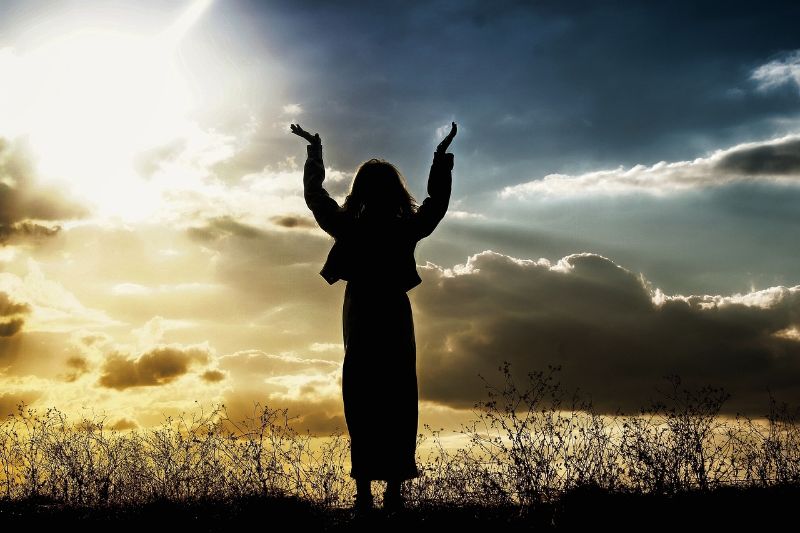
Traveling is about more than just viewing sights. It's an intense spiritual experience in which one might learn to connect with the unknown as well as oneself. It's a quest to go beyond one's comfort zone in order to get a deeper understanding of patience and endurance, as well as a profound sense of serenity, joy, and appreciation. You will grow and learn in some way, and that is exactly what travel is all about.
Before You Continue...
Do you know what is your soul number? Take this quick quiz to find out! Get a personalized numerology report, and discover how you can unlock your fullest spiritual potential. Start the quiz now!
While traveling may be a leisurely activity for some, there are a few fundamental strategies that will enrich your experience and turn it into a spiritual journey.
Every journey we take should have a goal in mind and a deeper significance. Travel can become a hollow pastime, a never-ending pointless party, or just another thing to consume if it isn't done with a purpose or intention.
The journey is more like a seed we plant in the ground, and our intentions are what will help us develop and flourish, enriching our experiences beyond our wildest dreams. Any aim is valid as long as it adds something to our lives, whether we want to relax on a beach in Thailand, learn how to make quesadillas in Mexico, or explore the ruins of Machu Picchu to learn more about the Incas' history.
Throughout my month in Bhutan (which is regarded as one of the world's happiest countries), I attempted to sense people's goodness and comprehend how most of them might go out of their way to aid me. Their attitude toward me shifted my perspective on life and made me a more patient traveler.

If you're about to embark on a journey and can't seem to figure out why you're going or what you want to get out of it, try the following.
- Take a notebook and make a list of at least five things you want to learn from this trip.
- Make a mantra for yourself and keep it in mind throughout your journey. It could be as basic as trying out one new item per day that you haven't done before.
Lesson – Focusing on our aims will not only assist us in discovering a deeper purpose for our path, but will also assist us in our daily lives. We'll be able to see that everything happens for a reason and that nothing happens by accident.
People lose loved ones and valuable possessions, and they frequently grieve for days. Travelers, on the other hand, understand that things will go at their own pace, that things will fall apart, and that there will be friends we will never see again.
Nothing lasts forever, that is a fact of life. Other than Buddhist monks, only travelers understand and accept the significance of impermanence. We may learn to confront the storm like an expert and accept all that comes our way gently through meditation. It's critical to remember that ‘this, too, shall pass.'
It is critical to set aside some time for meditation on your journey, even if it is only 5 minutes in the morning when you wake up or at night before going to bed. It's a technique that will assist you in realizing that no matter how good or horrible something is, it won't last long. Daily meditation will eventually assist us to maintain our thoughts floating and flowing instead of sticking to them.
Lesson – No matter how lovely the voyage is or how far it takes us, it will eventually come to an end. Live in the moment since it will never come again.
The power of observation is something I talk about a lot when I'm talking about travels. While most people (especially visitors) have a tendency to rush from one site to another in order to see as much as possible in a limited amount of time, I would advise you to take your time and observe. You may miss out on a lot of stuff, but whatever you do see will help you connect with the location better.
When you ask any genuine nomad what they enjoy most about travel, ‘watching people' is usually near the top of their list. I would often sit in a roadside cafe, a park, or the beach and observe the people around me. Often, I focus more on the indigenous, attempting to comprehend how their lives would be, what their daily challenges would be, what would make them happy, and so on.
When I was in Singapore, I met an Uber driver and learned that he was a Chinese farmer who had relocated with his family in order to offer a better education for his children. He expressed his desire to return to his village and live out his days there. I realized that ‘home' is such an essential place for everyone, and despite the fact that he lived with his immediate family, he desired to return to the place where his ancestors had lived.

Lesson: The journey is more important than the destination. Only by taking the time to observe will we be able to appreciate the beauty that exists in everything, as well as connect with the individuals we meet along the path.
Giving something back to the host country is one way to make trip more meaningful. And what could be better than donating your time to a worthy cause? In today's world, there are a number of disadvantaged individuals living in various regions of the globe who are far from the reach of development and still need fundamental essentials such as good healthcare and primary education.
The greatest method to help is to volunteer for a cause that will put you in direct contact with folks who are in need. Know that no matter how tiny a step you take, you will have an impact on someone's life.
Another option is to get involved in some form of environmental work. Perhaps you could help the environment by planting a few trees in your neighborhood or picking up trash on the streets. No one would come to thank you for your efforts, but you'd know deep down that you'd made a difference.
Lesson – We must make an offering in order to form a stronger bond with the places we visit. It doesn't have to be anything significant, but it must be meaningful.
Speaking from personal experience, I know how natural and easy it is to become weary while driving. Hundreds of things never operate as they should, many things fall out of place, errors occur, and situations become difficult. But if we take a moment to reflect, we'll see that each of those circumstances contributes to your tale and helps us grow. Every event we encounter and every person we meet along the way teaches us something new.
Rather than whining, “Why did this happen to me?” express gratitude by saying, “Thank God this occurred to me.” “Smile and appreciate the fact that this happened to you because the Universe knows you're strong enough to deal with the issue,” said a friend who recently gave me some wonderful advise.
Consider that there are countless other people all across the world who would gladly take your place! Aren't these reasons enough to be grateful for? You have the freedom to live your life as you wish, to travel beyond national borders, to meet people who don't speak your language, to gorge on international cuisine, and to witness the myriad colors of sunsets in different countries aren't these reasons enough to be grateful for?
Lesson – As I previously stated, traveling is a conscious exercise that develops our sense of gratitude in our lives. Begin to express thankfulness, and you will see a change in the environment around you.

Above all, you must make a commitment to your trip. As a frequent traveler, I've discovered that it's not as luxurious as it appears on the surface, but what in life is truly smooth? My travels have taught me lessons that no one ever taught me in school. On the road, I met some of the most amazing people and formed lifelong friendships. A friend I met on one of the most memorable travels taught me about the amazing technique of ‘Vipassana' meditation.
Before I go, I'd like to emphasize that no matter where you travel, just soak it all in and give yourself plenty of time to take in the sights.
What is a spiritual journey called?
= everything, and Theos = God) “God is All” and “All is God” are the literal translations. It is the belief that everything is a manifestation of an all-encompassing immanent God, or that the universe, nature, and God are one and the same. More elaborate definitions tend to highlight the idea that the theological principle of ‘God' represents or personifies natural law, existence, and/or the universe (the sum total of all that has been and will be).
- Parapsychology is the study of evidence regarding phenomena in which a person appears to affect or obtain information about something in ways that are not currently explainable by mainstream, conventional science. The majority of proponents of these occurrences believe they are the result of inexplicable mental powers.
- The physical world, as opposed to a spiritual or supernatural essence, is the component of the universe made up of matter.
- Pilgrimage: A long journey or search of significant moral value, primarily used in religion and spirituality.
- It can also be a pilgrimage to a sacred site or shrine that is significant to a person's faith and beliefs.
- Pilgrimages are attended by people of all faiths.
- A pilgrim is someone who undertakes such a journey.
- A plane of existence (also known as a dimension, vibrating plane, or an inner, invisible, spiritual, supraphysical world or egg) is a theoretical region of space and/or consciousness beyond the known physical universe, or the region containing the universe itself, in metaphysics and esoteric cosmology.
- Many esoteric teachings (such as theosophy and rosicrucianism) advocate for the existence of a vast network of subtle planes, worlds, or dimensions that, radiating from a central point, interpenetrate the physical planet on which we live, the solar systems, and all of the universe's physical structures. This interpenetration of planes culminates in the universe as a physical structured, dynamic, and evolutive expression emanated through a series of stages, becoming progressively more material and embodied from The Supreme Being: which allows the irruption of auto-Singularities from Its unintelligible Chaos, as the Big Bang did.
- Prayer is an attempt to interact with God, or a god or deities, or another sort of spiritual entity, or otherwise, to offer praise, make a request, or simply express one's thoughts and emotions.
- Prophecy is the prediction of future occurrences in a broad sense. Pro- “before” + the root of phanai “say,” i. e. “speaking before” or “foretelling,” although prophecy frequently indicates the involvement of supernatural phenomena, whether it be communication with a god, the interpreting of magical signs, or astrology. It's also a catch-all term for the manifestation of divine intent.
How do I start spiritual practice?
First and foremost, you must establish some structure in order for this strategy to succeed. Make a list of at least four things you can imagine doing every day in service of your highest self, using the four categories stated above.
Feel free to add whatever you're inspired to, and if you need some inspiration, consider the following:
- Holding or meditating with a crystal of your choice might help you tap into its energy.
It's critical to organize your time now that you've picked your choices. What is the minimum and greatest amount of time you are willing to spend on your morning routine, given that daily activities perform best when experienced first thing in the morning? It's critical to be honest with yourself when making this decision. You must be realistic in order to be consistent. How long do you have? 15 minutes? 45 minutes? Is it really two hours?
I've found that having two different versions of my daily practice helps me stay on track no matter what my schedule is. If I'm pressed for time, I can do one in 15 minutes, and on days when I have more time, I can do one that lasts 45 to 60 minutes.
Which country is famous for spirituality?
We analyzed data from every country in the world to determine the world's most spiritual country, and Canada came out on top in our Global Spirituality Index.
Spirituality is a multi-faceted notion, and defining a spiritual country entails more than just looking at countries with a substantial religious population.

While religion was obviously a major element in our analysis (we looked at religious diversity, religious freedom, religious tolerance, and the religious population), we also looked at quality of life, wellness and mindfulness, and spiritual sights.
Continue reading to learn more about the full results of our Global Spirituality Index as well as the methodology used to conduct our research.
Results
After receiving excellent marks for quality of life and religious diversity, as well as religious freedom, religious tolerance, spiritual sights, and wellbeing, Canada was named the world's most spiritual country.
For us at Wayfairer, it was particularly interesting to see which of our own destinations ranked highly on the Global Spirituality Index, and we were pleased to see India rank among the top five countries due to its high religious diversity and array of spiritual sights, as well as our newest destination, Japan, ranking third. We were also ecstatic to see Thailand ranked among the top 20 nations.
Methodology
To construct our Global Spirituality Index, we looked at a number of characteristics for each country around the world in order to get a comprehensive picture of spirituality in each one. We looked at the following elements:
Every country was given a score from 1 to 7 in each of these criteria (7 being the highest). The Global Spirituality Index Score was calculated by adding each country's scores across these areas, with a total of 49 being the highest possible score.
The Global Spirituality Index was created by ranking the countries based on their Global Spirituality Index Score.
- https://www.telegraph.co.uk/travel/maps-and-graphics/most-religious-countries-in-the-world/
For the following countries, data was not available: Andorra, Anguilla, Antigua and Barbuda, Bahamas, Barbados, Belize, Benin, Bermuda, Bhutan, Brunei Darussalam, Burkina Faso, Burundi, Cape Verde, Cayman Islands, Central African Republic, Chad, Comoros, Congo, Cuba, Democratic Republic of Congo, Djibouti, Dominica, East Timor, Equatorial Guinea, Eritrea, Faroe Islands, French Guiana,